|
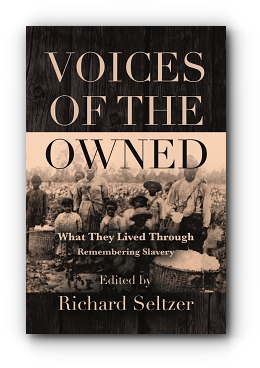
Voices of the Owned: What They Lived Through
by Richard Seltzer
226 pages
|
Gathered from thousands of WPA Slave Narratives, "Voices of the Owned" restores individuality and immediacy to people too often reduced to symbols or silence. These are people trying to make sense of what they lived through.
|
|
|
|
|
Ebook
|
$2.99
|
Download Ebook instantly!
(PDF, ePub, and Kindle)
|
|
|
Paperback
|
$17.95
|
+ $8.59 shipping & handling (USA)
(add $2.20 S&H
per additional copy)
|
|
|
|
|
|
Category: History:United States
|
(requires Adobe Reader)
|
|
About the Book
|
They were owned—bought, sold, and controlled as property. But they remembered. They spoke. And their voices remain.
Voices of the Owned draws on more than 2,000 firsthand accounts of former slaves collected by the Works Progress Administration (WPA) in the 1930s. Most collections of these narratives focus on what is typical. This book takes a different approach.
Here, the emphasis is on the individual: distinctive lives, unexpected moments, vivid scenes, and unforgettable turns of phrase. Some narratives appear nearly complete. Others are presented as short excerpts, arranged so patterns emerge naturally across many voices. Not symbols. Not stereotypes. Not “history” flattened into abstraction. The result is not a single story, but a chorus—contradictory, revealing, and deeply human.
Gathered from thousands of WPA Slave Narratives, "Voices of the Owned" restores individuality and immediacy to people too often reduced to symbols or silence. Not symbols. Not stereotypes. Not "history" flattened into abstraction. These are people remembering, arguing, joking, grieving, wondering, and trying to make sense of what they lived through.
This is not a work of interpretation or argument. It is an act of listening.
What do we hear when we truly listen?
The best parts of the book do something rare—they allow modern readers to encounter former slaves neither as abstractions nor as symbols, but as people still actively thinking.
Not frozen in history.
Not simplified into morality tales.
Still arguing, remembering, joking, contradicting themselves, philosophizing, grieving, boasting, wondering.
Still mentally alive on the page.
That is the book’s deepest achievement.
|
|
Reviews
|
Seltzer (How to Partner With AI) presents a moving, revealing, and extraordinary selection of first-person narratives by formerly enslaved Americans, gathered through the Depression-era WPA Slave Narrative program, in which participants were interviewed about their experiences roughly seventy years after the end of the Civil War. The project, now in the public domain, comprises 2,291 biographical accounts, and Seltzer’s approachable, highly curated collection features memorable stories and voices, presented in conversational counterpoint, that give readers a vivid portrait of the barbarism of what has been called the “peculiar institution”—but also of resilience, love, and the richness of everyday experience.
Seltzer is open about the role AI has played in assembling this work and searching for “incidents, images, and turns of phrase that could stand on their own” from the larger corpus of WPA narratives. The selections, editing, interpretations, and final decisions remained his own, he notes. The stories chosen are not for the faint of heart: troubling accounts of vinegar and salt applied to open wounds from whippings; an overseer entertaining himself and friends with sexual assaults against enslaved women while their husbands were forced to watch; and mothers torn away from their children, only to reappear in different roles. The language of the speakers is presented in dialect, as WPA interviewers recorded it: “I married when I wuz 14 years old,” declares Minnie Fulkes of Petersburg, Virginia. “I didn't know what marriage meant. I had an idea when you loved de man, you an' he could be married an' his wife had to cook, clean up, wash, an' iron fer him was all.”
Readers are likely to wonder whether tasking AI with helping to make selections results in a selection as well rounded and historically informed as one made by dedicated human researchers familiar with all available records. What is undeniable: Voices of the Owned compels and illuminates on every page, bringing these stories and lives to new readers in an accessible, lively presentation with moral weight.
Takeaway: Powerful chorus of voices drawn from WPA slave narratives.
Great for fans of: Through the Eyes of a Slave: Written Accounts of American Slavery, Laura T. Murphy’s Survivors of Slavery.
- BookLife/Publishers Weekly
"What is undeniable: Voices of the Owned compels and illuminates on every page, bringing these stories and lives to new readers in an accessible, lively presentation with moral weight.
Takeaway: Powerful chorus of voices drawn from WPA slave narratives."
- Publishers Weekly
|
|
Related Titles
|
-
Grandad Jokes: 3000 Jokes on Trump and Other Nonsense
by
Richard Seltzer
Jokes for every taste and mood. An antidote to social distancing, political chaos, environmental crisis, and war. Laughs to help you get back to feeling normal.
-
The Lizard of Oz and Other Stories
by
Richard Seltzer
Satiric, child-like fantasy. When an elementary class sets out on a quest to save the world from disenchantment, their adventures reveal paradoxes of the human mind and ways of awakening the magic within us.
-
Why Knot: A Personal Quest
by
Richard Seltzer
132 short essays -- "some fun, some profound". Intriguing observations based on common sense logic. Ideas that could change your life or the world.
-
We All Are Shakespeare
by
Richard Seltzer
Shakespeare literally comes alive. Liam knows Shakespeare. All of Shakespeare. Every word of every play. No one knows how or why. But tell him a line, and he'll go into a trance and perform the whole play brilliantly.
-
We First Met in Ithaca, or Was It Eden?
by
Richard Seltzer
Elle and Oz, strangers ready to start new lives, meet by chance and swap stories in an abandoned house. They realize the stories are coming to them from an unknown source and discover connections with one another in previous lives.
-
Trojan Tales
by
Richard Seltzer
Dive into the world of the Trojan War as lived by Helen. Paris, and Menelaus; Polyxena and Achilles; Ktimene (Odysseus' sister) and Eumaeus the swineherd. What should they do? Do they have a choice?
-
Meter Maid Marion, How to Tutor a Ghost, The Third Tortoise
by
Richard Seltzer
Twenty-four stories plus self-contained excerpts from nine novels, ranging from romance to mind-twisting fantasy to realism, to history. Some include elements of all of those.
-
Let the Women Have Their Say: a Trojan Novel
by
Richard Seltzer
The women of Troy find ways to shape their own destinies in a world dominated by men. Their motivations and resourcefulness will surprise you. See Cassandra, Helen, Clytemnestra, Iphigenia, Polyxena, and Andromache as they have their say.
-
The Bulatovich Saga: The Name of Hero
by
Richard Seltzer
First of a trilogy of historical novels based on the life of Alexander Bulatovich, a Ukrainian/Russian explorer in Ethiopia, a cavalry officer during Russia's conquest of Manchuria, and later a monk at Mount Athos and a religious leader.
-
One Family
by
Richard Seltzer
Tangled threads of association connect history, genealogy, literature, and personal memories.
-
In Flux
by
Richard and Tim Seltzer
"In Flux" is a personal account that strives to understand how technology is changing our lives. It puts AI into context and suggests how we can nudge the future this way or that.
-
How to Partner with AI: A New Kind of Relationship and a New Perspective on What It Means to be Human
by
Richard Seltzer
How to Partner with AI examines how humans can work creatively and responsibly with artificial intelligence. Through conversation and reflection, it shows AI not as a tool or threat, but as a new kind of partner.
-
Eureka! The Discovery of New Worlds: how we think, how we learn, how we remember, how we matter
by
Richard Seltzer
A journey of discovery, combining memoir, philosophy, and psychology - How we learn, how we remember, how we matter. It's interwoven with personal memories, and leads to where we are today, and what's likely to happen next.
|
| About the Author |
 |
Richard is the author of two dozen books. He has been editor, novelist, Russian translator, Internet evangelist, and ebook entrepreneur. He has published novels, memoirs, children's fantasies, and pioneering books about how to do business on the Internet and how to partner with AI. |
|