
| ||||||||||||
| Category: Biography:Historical | |
| About the Book | |
|
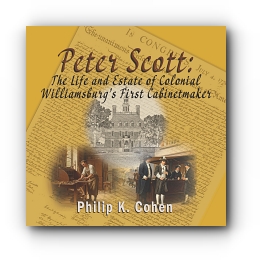
The first half of this book traces Peter Scott’s family history and describes his life as colonial Williamsburg’s first cabinetmaker, a city councilman, a private banker, and a property owner. His cabinetmaking is discussed primarily from an economic rather than aesthetic perspective, since his craftsmanship has been definitively addressed elsewhere. As the youngest son of a prosperous and important family in the Scottish Borders, Peter (1695 – 1775) would not succeed to become Scott of Burnhead. Therefore, he had to make his own way in the world. Following his youth in Roxburghshire, Scotland, and apprenticeship, probably in London, he relocated to Williamsburg around 1722. This bold action is placed within the larger pattern of Scottish emigration. The origin and development of Williamsburg are outlined, and the location of his residence/shop is firmly placed on a plat map of the town. The second half focuses on the only surviving copy of the Account of Administration (AoA) of his estate, a manuscript acquired by the author and donated to the Colonial Williamsburg Foundation. It reads like a Who’s Who of colonial Williamsburg. Among the debtors to his estate were Colonel John Henry, father of Patrick Henry, and Thomas Jefferson, whose dealings with Scott and his executor are analyzed in detail. The AoA’s structure and accounting are thoroughly explicated. Attention shifts from Scott to his estate and surviving executor, Robert Nicolson, a fellow Scotsman, tailor, and investor. In order for the reader to understand Nicolson's strategies and actions to preserve the value of Scott's estate, which was frozen during the Revolutionary War because his principal heir lived in the enemy territory of Great Britain, interdisciplinary context is necessary. The impact of relations between the colonies and Britain before, during, and after the war as independent states in a new nation, are outlined with emphasis on international trade. The commercial practices of Virginia’s credit-driven economy, centered in the capital city of Williamsburg, are addressed, as are international monetary and trade systems, balance of trade, exchange rates, and bills of exchange. Absent institutional banks, currency exchanges, and checking accounts, but faced with essentially the same commercial needs as modern economies, the colonies found effective ways to conduct business. These are described because they apply to Nicolson's responsibilities as executor. Aspects of Virginia probate law and court systems also receive attention, along with the methods employed by Virginia and the Continental Congress to finance the war. These practices, including excessive but necessary emissions of paper currency, and loan office certificates, led inevitably to currency depreciation. This depreciation cut deeply into Scott's estate. Armed with the necessary background, the reader can understand the options available to Nicolson and the decisions he made. Modern-day visitors to Colonial Williamsburg will recognize many of the names mentioned in the book but will encounter some, e.g., that of Mrs. Richardson, Scott’s laundress, for the first time. And they can now witness progress on the reconstruction of Scott’s residence on Duke of Gloucester Street. Examples of Scott's cabinetry are on exhibit in Colonial Williamsburg, as well as at Washington's Mount Vernon. Jefferson’s Monticello also has an example.
|
|
| About the Author | |
 |
Phil Cohen earned his Ph.D. in English Literature and has published books and articles in his specialty. This book, inspired by his brother’s devotion to colonial Williamsburg and his own consequent acquisition of related 18th-century manuscripts, is his first venture into the field of American history. |