
| ||||||||||||||||
| Category: Business:Marketing |
(requires Adobe Reader)
|
| About the Book | |
|
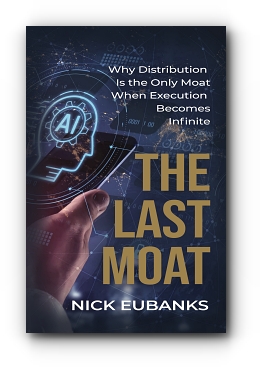
When execution becomes infinite, the last defensible moat is distribution. In May 2024, Google's AI Overviews began synthesizing answers directly in search results. Within weeks, websites that had spent years building organic traffic saw click-through rates drop 25-40%. Revenue collapsed. But the problem wasn't the algorithm—it was their architecture. The Last Moat reveals why traditional competitive advantages are evaporating and what replaces them: structural control over how demand finds supply. Every business book mentions AI as a productivity tool. This one addresses what they ignore: when AI makes execution nearly free and compresses visibility around central nodes, what determines which companies survive? The answer has profound implications. Mid-market firms generating $10M-$100M in revenue are experiencing margin compression they cannot explain. Customer acquisition costs spike while effectiveness plummets. Traffic sources that seemed diversified turn out to concentrate under single platforms. Companies appear healthy until coordination layers shift—then fragility reveals itself overnight. This book provides the frameworks leaders need: The Dependency Index measures hidden exposure to external coordination layers. Most companies believe they're diversified because revenue flows through multiple channels. The Index reveals that organic search, paid search, and content marketing often trace back to one governance authority. What appears as six channels is actually one dependency. The Independence Stack maps five layers from fragile participation to structural control: production, distribution, identity, infrastructure, and governance influence. Each layer requires different investments and produces different resilience. The book shows when to climb and how. Four Viable Strategic Paths for competing against giants: vertical domination within narrow niches, narrative reframing that repositions incumbents as outdated, ecosystem embedding before consolidation occurs, and distributed enablement that empowers rather than aggregates. Each path circumvents rather than confronts dominant platforms. The Centrality Score quantifies influence within categories through citation density, terminology adoption, and institutional alignment. In AI-mediated markets, centrality determines inclusion probability. The book shows how to engineer it deliberately. Drawing on detailed case studies—from newspapers losing distribution control, to TechSource's margin compression on Amazon, to Sarah's outdoor gear company escaping dependency through community transformation—The Last Moat explains patterns that repeat across industries and eras. When production becomes abundant, coordination concentrates. Power migrates to those who control access between supply and demand. Artificial intelligence accelerates this cycle. As AI synthesis replaces ranked lists, inclusion becomes binary rather than graduated. As recommendation engines surface three options instead of ten, the competitive gradient steepens. The firms positioned at coordination layers strengthen their gravity. Those operating beneath face mounting pressure. The strategic choice is urgent: Companies have perhaps 18-36 months to reposition before coordination layers fully consolidate around AI-mediated interfaces. Written by a serial entrepreneur who built, scaled, and sold companies on both sides of the distribution equation, The Last Moat provides diagnostic tools, architectural strategies, and capital allocation frameworks that mid-market leaders can implement immediately. This isn't theory. It's operational experience translated into actionable intelligence for navigating the largest restructuring of competitive advantage since the internet—compressed into quarters rather than decades.
|
|
| About the Author | |
 |
Nick Eubanks is a serial entrepreneur with five exits. In 2023, he sold From The Future and Traffic Think Tank—buyers valued them radically differently based on one variable: control over demand. As former VP of Owned Media at SEMrush, he deployed capital to build distribution infrastructure at scale. He's lived both dependency and escape. |