
| ||||||||||||||||
| Category: Politics:Economic Policy |
(requires Adobe Reader)
|
| About the Book | |
|
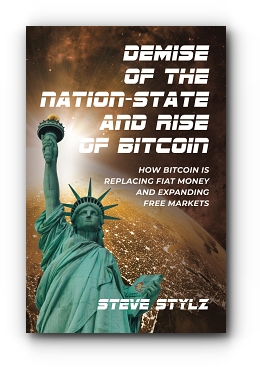
For centuries the nation state has stood as the dominant structure of political and economic life. It drew borders, issued currency, enforced law, taxed production, and claimed authority over violence within its territory. Its power rested on control of money, information, and force. For generations these pillars appeared permanent. Technology began to erode them. The printing press weakened religious monopolies. The telegraph and telephone accelerated cross border commerce. The internet dissolved information control. Email diminished the relevance of state postal monopolies. Each advance reduced dependence on centralized authority. Institutions did not collapse overnight. They became less essential. Money remained the final fortress. Modern governments finance themselves not only through visible taxation but through monetary expansion. Fiat currency issued by central banks enables deficit spending, war financing, and endless debt creation. Inflation operates as a silent tax. Savings erode. Asset prices distort. Dependency deepens because alternatives appear limited. Bitcoin introduces an alternative. Launched in 2009 after a global financial crisis, Bitcoin is not merely digital currency. It is a decentralized monetary network with no central issuer and no national allegiance. Its supply is fixed. Its rules are transparent. Its ledger is distributed across thousands of independent nodes worldwide. Participation is voluntary. Ownership is secured by cryptography rather than decree. For the first time in modern history, individuals can opt out of a state monetary system without leaving their country. They can store value beyond inflationary dilution. They can transact globally without traditional banks. They can hold wealth that cannot be expanded by political decision. This shift is subtle yet profound. When monetary control weakens, state leverage weakens. Capital becomes mobile. Tax enforcement grows complex. Monetary policy loses certainty. Governments may regulate exchanges and restrict access, but they cannot alter Bitcoin’s supply or rewrite its protocol without global consensus. The monopoly fractures. The pattern mirrors earlier disruptions. Email did not abolish postal systems overnight, but it reduced their dominance. Streaming did not instantly eliminate cable, yet it reshaped media economics. Bitcoin does not topple governments in a single event. It makes certain functions less central and less commanding. As adoption spreads, a parallel financial architecture forms. Individuals gain sovereignty over savings. Cross border trade moves with less friction. Remittances bypass costly intermediaries. Wealth migrates toward assets resistant to debasement. Financial power disperses. This does not guarantee chaos. It introduces competition. Governments must compete with open networks. Monetary credibility must be earned rather than imposed. Citizens gain optionality. Voluntary systems expand while coercive structures face pressure. The decline of the nation state does not imply disappearance. It signals transformation. States may integrate digital assets, reform fiscal policy, or redefine their role in a world where monetary sovereignty is no longer absolute. The era of uncontested control fades. Bitcoin represents more than financial innovation. It reflects a philosophical shift. Trust migrates from institutions to mathematics. Authority moves from hierarchy to distributed consensus. Cooperation emerges without central command. Resistance will intensify. Regulation will evolve. Narratives will clash. Yet technological change follows a persistent logic. When a tool offers transparency, efficiency, and individual empowerment, adoption advances. Bitcoin is to represent value, a tool voluntary exchange, Nation State violence. This is what is evolving.
|
|
| About the Author | |
 |
Steve Stylz is an independent author exploring the transformation of money, power, and voluntary systems in the digital age. In The Demise of the Nation-State and Rise of Bitcoin, he examines how Bitcoin challenges fiat structures and reshapes sovereignty, governance, and individual freedom in a rapidly decentralizing world. |